How to Store Leftover Paint for Future Touch-Ups
Finishing a painting project doesn’t always mean finishing the tin of paint. In fact, keeping a little leftover paint can be incredibly useful for those inevitable marks, scratches and small repairs that appear over time.
A scuff from moving furniture, a chip around a doorway or a small patch after repairing a wall can often be fixed quickly if you still have the original paint. The challenge is making sure that leftover paint is stored properly, clearly labelled and still usable when you need it months — or even years — later.
Here are some simple ways to store leftover paint and give it the best chance of staying in good condition.
Why Keeping Leftover Paint Is Worth It
Even when you know the original colour name, buying a new tin later doesn't always guarantee a completely invisible touch-up.
Paint on your walls naturally changes slightly over time due to sunlight, cleaning, wear and environmental conditions. There can also be subtle differences between batches.
Keeping some of the paint originally used on the surface gives you the best starting point when you need to make a small repair.
This is particularly useful for:
High-traffic hallways
Doors and door frames
Skirting boards and architraves
Children's bedrooms
Kitchens
Living areas
Feature walls
Exterior trim
A properly labelled container also saves you trying to remember whether the colour in the lounge room was White on White, Natural White, Lexicon Quarter or one of the many other whites that suddenly look remarkably similar six months later.
Seal the Paint Container Properly
Air is one of the main enemies of stored paint.
Before closing the tin, clean excess paint from around the rim so the lid can form a proper seal. Make sure the lid is firmly secured all the way around rather than simply pressing down on one side.
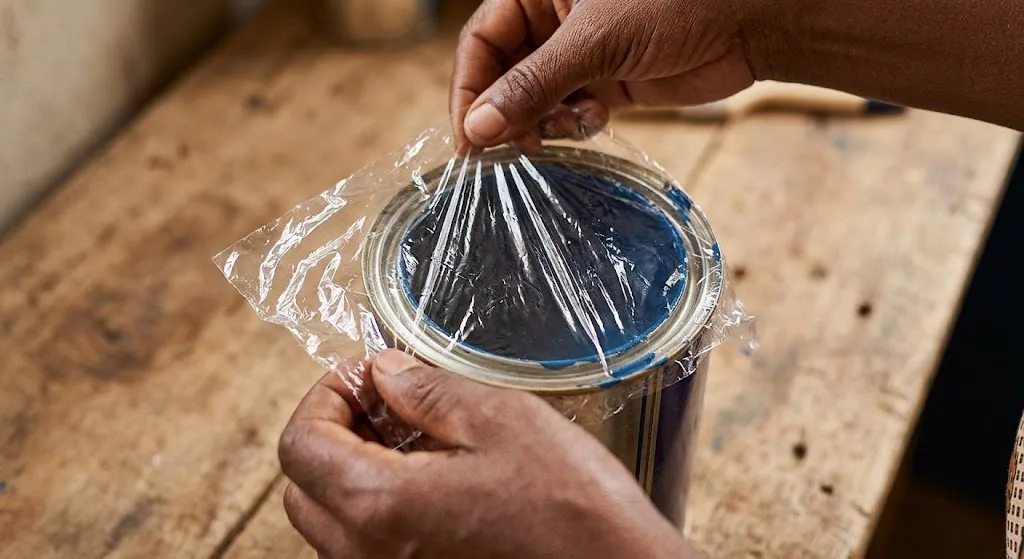
You can also place a layer of plastic wrap over the opening before replacing the lid if you want an additional barrier between the paint and the air.
Avoid damaging the rim of the tin when opening or closing it. A bent or damaged rim can prevent the lid from sealing properly, allowing air into the container and causing the paint to dry out or develop a skin.
Once closed, check that the container isn't leaking before putting it away.
Store Paint Away From Temperature Extremes
The back corner of the garage or garden shed might seem like the obvious place to store leftover paint, but it isn't always ideal.
Australian garages and sheds can become extremely hot during summer and surprisingly cold during winter. Large temperature changes can affect the consistency and condition of some paints.
Where practical, choose a cool, dry and well-ventilated location that is protected from direct sunlight and extreme temperatures.
Keep paint away from heaters, open flames and other heat sources, and always follow any storage instructions provided on the original container.
Paint should also be kept somewhere secure and out of reach of children and pets.
Label Your Leftover Paint Clearly
This might be the most important step of all.
A collection of half-used tins marked only as "white", "grey" or "bedroom" becomes surprisingly confusing after a couple of years.
Before storing the paint, write as much information as possible on the container.
Useful information includes:
Paint brand
Colour name
Colour code if available
Paint type
Finish, such as matt, low sheen, satin or gloss
Room where it was used
Surface it was used on
Approximate date the area was painted
For example:
Dulux Natural White – Low Sheen – Lounge Room Walls – Sept 2026
For trims, you might write:
White Semi Gloss – Hallway Doors, Frames & Skirting – Sept 2026
You can even take a photo of the paint label and save it in a folder on your phone. If the label becomes damaged later, you'll still have the details.
Transfer Small Amounts Into a Suitable Airtight Container
If you only have a small amount of paint left in a large tin, there may be a lot of air sitting inside the container.
In this situation, transferring the remaining paint into a smaller suitable airtight container can make storage easier and reduce the amount of air surrounding the paint.
Make sure the container is clean, dry and appropriate for storing paint.
Most importantly, label the new container immediately.
Don't rely on your memory.
A small unlabelled jar of off-white paint isn't particularly useful when you're trying to work out whether it belongs to the kitchen, bedroom, ceiling or skirting boards.
Check the Paint Before Using It Again
Stored paint should always be checked before you start touching up a visible area.
When you open the container, look for signs that the paint has deteriorated.
Some separation during storage can be completely normal and may disappear once the paint is stirred thoroughly. However, paint that has developed an unusual smell, heavy lumps or a consistency that doesn't return to normal after mixing may no longer be suitable to use.
If you're unsure, test a small amount somewhere inconspicuous before applying it to the middle of a wall.
And remember that matching the paint isn't the only consideration. The existing surface may have changed slightly with age, sunlight and wear, so even the original paint can sometimes produce a noticeable touch-up.
In some situations, repainting the entire wall from corner to corner will give a much cleaner and more consistent result.
Don't Pour Unwanted Paint Down the Drain
If you eventually decide you no longer need your leftover paint, don't pour it into sinks, stormwater drains or onto the ground.
Paint and paint packaging can be disposed of responsibly through services such as Australia's Paintback program, which has collection locations for unwanted architectural and decorative paint.
Responsible disposal is a much better option than letting old tins accumulate indefinitely in the garage.
A Little Preparation Now Can Save Trouble Later
Keeping leftover paint doesn't require much effort, but a few simple steps can make a big difference.
Seal the container properly, keep it away from extreme temperatures, label it clearly and store it somewhere safe.
Then, the next time a wall gets scratched or a door frame gets chipped, you'll know exactly which paint was used instead of standing in front of five mystery tins wondering which shade of white is
